

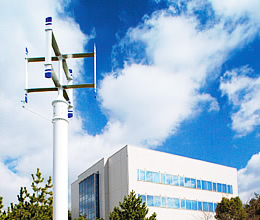
- Electrical Engineering Major
- Electrical energy is essential to our daily lives. As the gravity of global warming and depletion of our energy resources increases on a global scale, the transition to environmentally friendly power systems is highly anticipated. Electrical engineering is gaining attention as a technology which will resolve these problems. Given this background and after considering the objective of educating tomorrow's pioneering engineers, the following three education points have been defined.
-
- Specialized instruction by researchers in various fields including measurement and control, energy, electricity and electronic materials.
- Emphasis on hands-on training through experiments and practical training, and utilization of research facilities such as ecoelectrical energy.
- Training of real-world problem-solving skills and presentation skills.
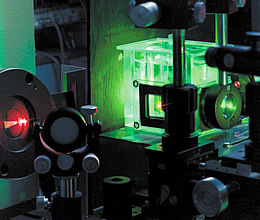
- Electronics and Information Network Major
Electronic information devices, including digital TVs, cellular phones and personal computers, and the information network which connects them are indispensable infrastructure for modern society.
In the first, students study the basic of Mathematics, Physics and Electrical and Electronic engineering. With this basic knowledge, students then study Electronic device, Electronic information system, and Information network system. The lecture covers both the hardware and the software of Semiconductor, Plasma system, Laser, Electronic circuit, Control, Computer, Programming, Embedded system, Audio and Image processing, Communication system, and Network.
The curriculum focuses on experiments and practices and arranges for many lectures for qualification. Through these lectures, students acquire advanced skills to support modern society.